Abstract
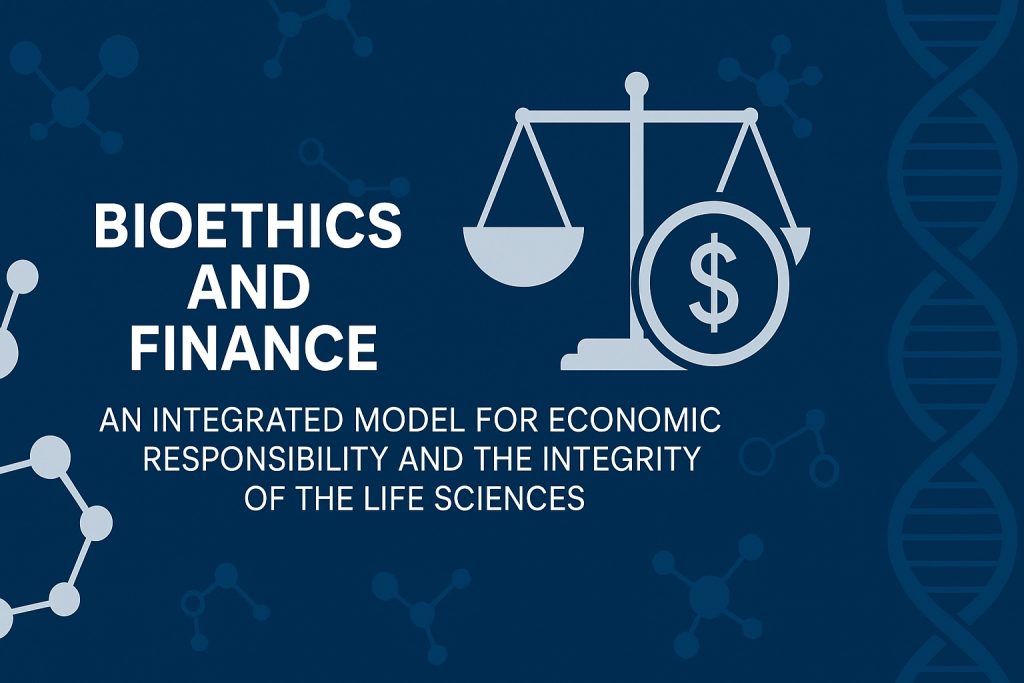
The expansion of biomedical technologies and the growing centrality of financial capital in the life sciences call for a systemic analysis of the connection between bioethics and finance. This article offers a broadened and entirely original reflection on the dynamics that shape the relationship between biotechnological development, investments, ethical governance, and sociobiological risks. It addresses topics such as the moral impact of investments, global asymmetries in access to innovation, speculation on genetic data, models of sustainable finance, and the need for an integrated framework that reconciles human values with market logic. The aim is to outline an operational paradigm capable of guiding public decision-makers, investors, and researchers toward a more equitable, transparent, and biologically responsible life economy.
1. Introduction
The transformation of the global economy in recent decades has radically altered the role of finance in scientific research. Biotechnological companies, once marginal entities heavily dependent on public funding, now operate as central players in medical and genetic innovation. At the same time, investment funds, banks, and regulated markets directly influence the direction of biomedical development. This interconnection requires a new ethical analysis: it is no longer sufficient to discuss the moral implications of the research itself; it is necessary to understand how economic mechanisms shape processes, scientific choices, and the distribution of benefits. Such awareness calls for an expansion of bioethics toward an integrated approach that includes the financial dimension as one of the arenas in which the values of human life are defined.
2. Finance and Biotechnology: Trajectories of Interdependence
Finance is not a neutral engine of innovation. Its choices establish priority hierarchies that affect public health. The rising costs of research, regulatory complexity, and the need for advanced technological infrastructures make the biotechnology sector highly dependent on both private and public capital. This dependency has tangible effects: some therapeutic areas receive massive investments (e.g., oncology, precision genetics), while others remain marginalized (rare diseases, tropical pathologies, the health of vulnerable populations). The current growth model risks privileging highly profitable innovations at the expense of global health justice.
2.1 Capitalization and Inequalities
The way capital is allocated has direct implications for global inequalities. Biotech companies tend to invest in areas capable of generating rapid economic returns, neglecting less profitable clinical conditions. Countries with limited ability to attract investments remain excluded from the innovation cycle and depend on imported products or external aid. This asymmetry is also reflected in data generation: most clinical studies are conducted in high-income regions, leaving many populations underrepresented. Inequality thus becomes biological as well as economic.
2.2 Biological Speculation: Risks and Critical Issues
Emerging biotechnologies present high financial volatility due to uncertain outcomes, long development timelines, and regulatory complexity. This context fosters speculative behaviors: startups inflated beyond their real value, pressure to shorten clinical trials, and excessive promises in institutional communications. Such dynamics not only undermine scientific credibility but can increase risks to public health and create unfounded expectations among patients. The ethics of prudence should guide every phase of biotechnology financing, but it often remains subordinate to market logic.
3. The Bioethics of Investment: A New Paradigm
An advanced bioethical perspective can no longer focus exclusively on the experimental or clinical stage: it must also examine the financing process. The bioethics of investment emerges as a discipline that analyzes the moral dimension of capital allocation in the life sciences. It views investors not as neutral actors but as co-authors of innovation, jointly responsible for the social and biological impacts of economic decisions.
3.1 Ethical Principles for Capital Allocation
The main principles of traditional bioethics can be adapted to the financial sphere:
- Beneficence: promoting investments that produce concrete benefits for public health.
- Non-maleficence: avoiding support for technologies that are potentially harmful or insufficiently validated.
- Justice: promoting a fair distribution of the benefits of innovation.
- Autonomy: ensuring transparency of information so that investors and citizens can make informed decisions.
3.2 Transparency, Governance, and Accountability
A financial system that supports biotechnology should incorporate independent ethical oversight bodies, sociobiomedical impact assessments, and clear disclosure policies. A lack of transparency can foster conflicts of interest, data manipulation, and information distortion, with ethically and legally significant consequences.
4. Sustainable Finance and the Life Sciences
In recent years, ESG criteria have also been applied in the biotech sector, generating assessment tools that extend beyond purely economic parameters. These criteria make it possible to measure companies’ impact on human rights, genetic privacy, sensitive data management, and social equity. This approach enables a more responsible classification of enterprises and supports investment policies oriented toward collective well-being.
4.1 The Role of Impact Investing Applied to Biomedicine
Impact investing represents an alternative to traditional models, as it intentionally integrates social and health objectives into investment criteria. In the biomedical field, this may mean funding therapies for neglected diseases, supporting research in low-income countries, or backing technologies for early diagnostics. This model demonstrates that there is no incompatibility between economic returns and health equity.
5. Ethics of Genetic Data and the Biological Information Industry
Human DNA has become an economic resource of extraordinary value. Companies that collect, store, and analyze genetic information generate significant profits, often without clear regulation. This raises critical questions: who holds the rights over biological data? What are the limits of monetizing life? How can discrimination based on genetic information be prevented? Without an ethical and transparent regulatory framework, the growing genome economy can become a space of risk for human dignity.
6. Toward a New Integrated Model
To address emerging challenges, it is necessary to develop a model that combines bioethical values with financial instruments. Such a framework should include: biotechnology risk assessments, responsible economic analyses, indicators of health equity, and supranational ethical oversight mechanisms. Only an integrated approach can ensure that scientific innovations are guided not only by profitability but also by a commitment to the public good.
7. Conclusions
Bioethics and finance no longer represent separate realms. Their interdependence shapes the way contemporary societies understand life, health, and progress. Promoting ethically responsible finance means strengthening public trust in research, protecting human dignity, and guiding innovation toward a more equitable and sustainable future. Only by integrating economic responsibility and biotechnological integrity does it become possible to build a life economy that respects the human being in all its complexity.
Bibliography
- 1. Ferraro, L. (2023). Responsabilità etica dei capitali nelle scienze della vita. Journal of Biofinancial Ethics.
- 2. De Almeida, R. & Saunders, P. (2021). Equity and investment in disruptive biotechnologies. Global Health Economics Review.
- 3. Navarro, D. (2022). Governance e trasparenza nelle imprese biotecnologiche. International Journal of Life-Science Policy.
- 4. Cheng, H. (2020). Genetic data markets and the moral limits of monetization. Ethics & Genomics Quarterly.
- 5. International Council for Bioethical Finance (2022). Guidelines for Ethical Investment in Biotechnology.