
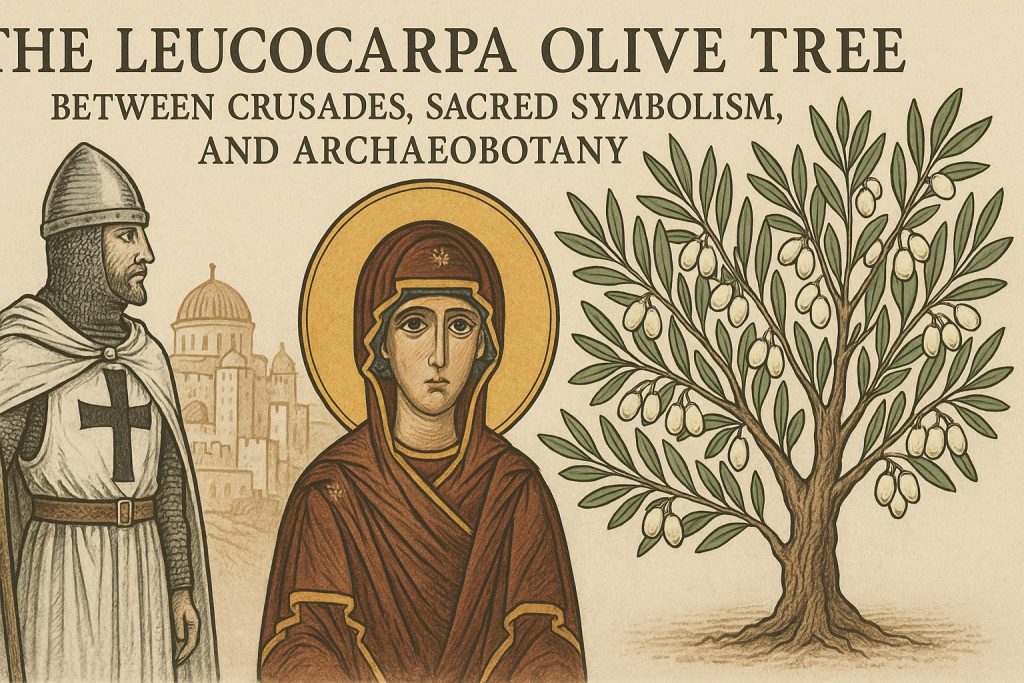
The Story of a Tree That Spans the Centuries
Introduction
Within the vast panorama of Mediterranean crops, the olive tree occupies a privileged place not only for its economic value, but also for its profound symbolic stratification. Among the more than one thousand known varieties, one stands out for its rarity, history, and mystery: the leucocarpa olive tree, characterized by fruits that turn white when fully ripe. This biological peculiarity has, over time, made it a sacred tree, linked to Christian liturgy, medieval monastic routes, and—according to a historically grounded tradition—the return of Crusaders from the Holy Land.
The aim of this essay is to reconstruct, through a historical-popular approach supported by archaeobotany, the cultural, religious, and biological journey of the leucocarpa olive tree, showing how a simple tree can become a living document of history.
1. The Olive Tree in the Mediterranean: Agricultural Plant and Universal Symbol
The olive tree is one of the earliest plants domesticated by humans in the Mediterranean basin, with origins dating back at least 6,000 years. In the ancient world, olive oil was used as:
- food,
- fuel for lighting,
- a base for therapeutic ointments,
- a ritual element.
In Greek culture it represented the wisdom of Athena; in the Roman world it was a symbol of peace and prosperity; in the biblical tradition it became a sign of the covenant between God and humankind. The anointing with consecrated oil—still central in Christian liturgy today—derives directly from these ancient roots.
In this context, the olive tree was never merely an agricultural plant, but a total cultural object, at the boundary between nature, religion, and power.
2. The Leucocarpa Olive Tree: Genetic Uniqueness and Symbolic Function
The leucocarpa olive is distinguished by an extremely rare characteristic: the absence of anthocyanin pigments, which are responsible for the dark coloration of ripe olives. The fruit remains light throughout ripening, assuming hues that range from ivory white to mother-of-pearl.
This biological peculiarity has had a deeply symbolic impact:
- white as the color of purity;
- light as a metaphor for divine presence;
- very pale oil as a perfect substance for liturgical use.
Leucocarpa oil was in fact mainly used:
- for lighting altars,
- for priestly anointings,
- in Easter and baptismal ceremonies.
The tree was not selected for agricultural yield—modest compared to other cultivars—but for its ritual value.
3. The Crusades as a Biological and Cultural Vector
Between the 11th and 13th centuries, Europe was swept by the great movement of the Crusades. Thousands of men traveled between West and Near East, generating not only armed conflict but also intense agricultural, botanical, and technological exchanges.
The Crusaders came into contact with:
- Eastern agricultural techniques,
- new plant varieties,
- religious traditions linked to the cult of oil.
According to a historically plausible tradition, supported by the geographical distribution of the oldest trees, the leucocarpa olive was introduced into Southern Italy precisely by:
- knightly orders,
- Eastern monastic communities (particularly the Basilian monks),
- pilgrims returning from the Holy Land.
It is no coincidence that the oldest specimens are often found near:
- medieval monasteries,
- hospices for pilgrims,
- isolated rural churches.
The tree thus becomes a biological testimony to Crusader routes—a living relic of medieval spirituality.
4. Archaeobotany: The Vegetal Memory of the Middle Ages
Archaeobotany is the discipline that studies plant remains from archaeological layers: seeds, pollen, wood, fibers, and fruit residues. Through these traces it is possible to reconstruct:
- ancient agricultural landscapes,
- ritual crops,
- patterns of species diffusion.
In the case of the leucocarpa olive, archaeobotanical and paleogenetic research suggests intentional selection for symbolic rather than productive purposes. Pollen analyses conducted in monastic contexts in Southern Italy show a significant presence of olive trees in sites exclusively linked to religious life.
This demonstrates that:
- leucocarpa was not cultivated for the market;
- its function was sacred and identity-forming;
- the tree was an integral part of the medieval spiritual landscape.
5. The Olive Tree as a “Living Relic”
In the Middle Ages, a relic was not only a saint’s bone, but any object believed to carry sacred power. The leucocarpaolive tree, planted near churches, assumed this value:
- it was not cut down,
- it was protected by the community,
- it often survived even the abandonment of the original religious sites.
Even today, many of these trees are classified as “monumental olive trees” and are well over 400–600 years old. They represent a form of biological archive, capable of crossing eras, political regimes, and social transformations.
6. Decline and Rediscovery in the Contemporary World
With agricultural modernization and the abandonment of rural areas, the leucocarpa has gradually lost its central role. Industrial oil has replaced ritual oil, and many liturgical practices have changed.
Today, the leucocarpa olive is considered:
- a variety at risk of genetic erosion,
- a cultural asset as well as a botanical one,
- an identity symbol of the southern Mediterranean.
In recent years, thanks to interdisciplinary studies and landscape protection projects, this variety is experiencing renewed appreciation, especially in the fields of:
- cultural tourism,
- education,
- environmental conservation.
Conclusion
The leucocarpa olive tree is an extraordinary example of how nature, faith, and history can merge into a single living organism. Born from a genetic mutation, carried along Crusader routes, consecrated in medieval monasteries, and now studied by archaeobotany, this tree tells a story that spans millennia.
It is not merely a rare plant, but a biological testimony of Mediterranean civilization—a document written in wood rather than on parchment. To protect it means to defend an invisible yet essential part of our collective memory.
Bibliografia
- Amouretti, M.C., L’olio e l’olivo nell’antichità, Laterza.
- Zohary, D., Hopf, M., Weiss, E., Domestication of Plants in the Old World, Oxford University Press.
- Fiorentino, G., Archeobotanica. Metodi e approcci, Carocci Editore.
- Petruccioli, P., Paesaggi rurali storici del Mediterraneo, FrancoAngeli.
- Menozzi, D., Storia della Chiesa nel Medioevo, il Mulino.
- AA.VV., Gli olivi monumentali del Mediterraneo, Edizioni Scientifiche Italiane.