
Abstract
Earth Day, celebrated annually on April 22, represents one of the most important global events dedicated to environmental awareness, sustainability, and intergenerational responsibility. This paper proposes an interdisciplinary reflection intertwining bioethics, environmental pedagogy, and the culture of sustainability, while highlighting a drawing created by a kindergarten pupil as a symbolic expression of an original ecological consciousness. The article argues that early environmental education constitutes a fundamental tool for the formation of responsible citizenship and for promoting a new ethical alliance between humanity and nature. Through the analysis of major international sources and contemporary educational perspectives, the study emphasizes the role of younger generations in building a culture of care for the Earth.
Keywords: Earth Day, environmental bioethics, ecological education, sustainability, childhood, intergenerational responsibility.
1. Introduction
Every year, on April 22, millions of people celebrate Earth Day, an international event established with the aim of promoting environmental protection and global ecological awareness. The observance, founded in 1970 in the United States and subsequently recognized internationally, has progressively become a symbolic and cultural space in which scientific, social, educational, and ethical concerns converge. (unep.org)
In the contemporary context, characterized by climate change, biodiversity loss, and increasing environmental inequalities, Earth Day acquires a significance that goes beyond mere commemoration: it calls for shared responsibility toward the planet and future generations. (unesco.org)
From this perspective, environmental bioethics provides a fundamental interpretative framework, as it invites us to consider the relationship between human beings and nature not in terms of exploitation, but of stewardship, reciprocity, and ecological justice. The environment is no longer perceived solely as an economic resource, but as a universal common good, essential to the dignity of both human and non-human life.
2. Historical Origins of Earth Day
The first Earth Day was celebrated on April 22, 1970, thanks to the initiative of U.S. Senator Gaylord Nelson, who was deeply affected by the consequences of industrial pollution and growing environmental devastation. The event involved approximately twenty million American citizens and represented one of the largest civic mobilizations of the twentieth century. (en.wikipedia.org)
The event contributed to the emergence of a new ecological awareness and encouraged the approval of important environmental legislation. In 2009, the United Nations officially proclaimed April 22 as “International Mother Earth Day,” recognizing the Earth as the “common home” of humanity. (unep.org)
Today, Earth Day involves more than 190 countries and represents a global platform for environmental education, sustainability promotion, and dialogue among institutions, schools, universities, and civil society. (time.com)
3. Environmental Bioethics and Intergenerational Responsibility
The contemporary ecological crisis cannot be addressed exclusively through technological or political instruments. It requires a profound cultural and ethical transformation. Environmental bioethics, which has developed over recent decades, places at its center the principle of responsibility toward all forms of life and toward future generations.
Hans Jonas, in his well-known “principle of responsibility,” argued that human action must ensure the permanence of authentic human life on Earth. This perspective appears particularly relevant today: safeguarding ecosystems represents an essential condition for the protection of health, social justice, and peace.
Ecological education therefore assumes a fundamental bioethical value. It is not merely a matter of transmitting scientific knowledge, but of fostering attitudes of respect, sobriety, solidarity, and care. UNESCO emphasizes that reconciling humanity with nature constitutes one of the main educational challenges of our time. (unesco.org)
4. Childhood as the Original Space of Ecological Consciousness
The participation of children in initiatives dedicated to Earth Day is particularly significant. Numerous pedagogical studies highlight how environmental sensitivity develops already in the earliest years of life through emotional, symbolic, and relational experiences with the natural world.
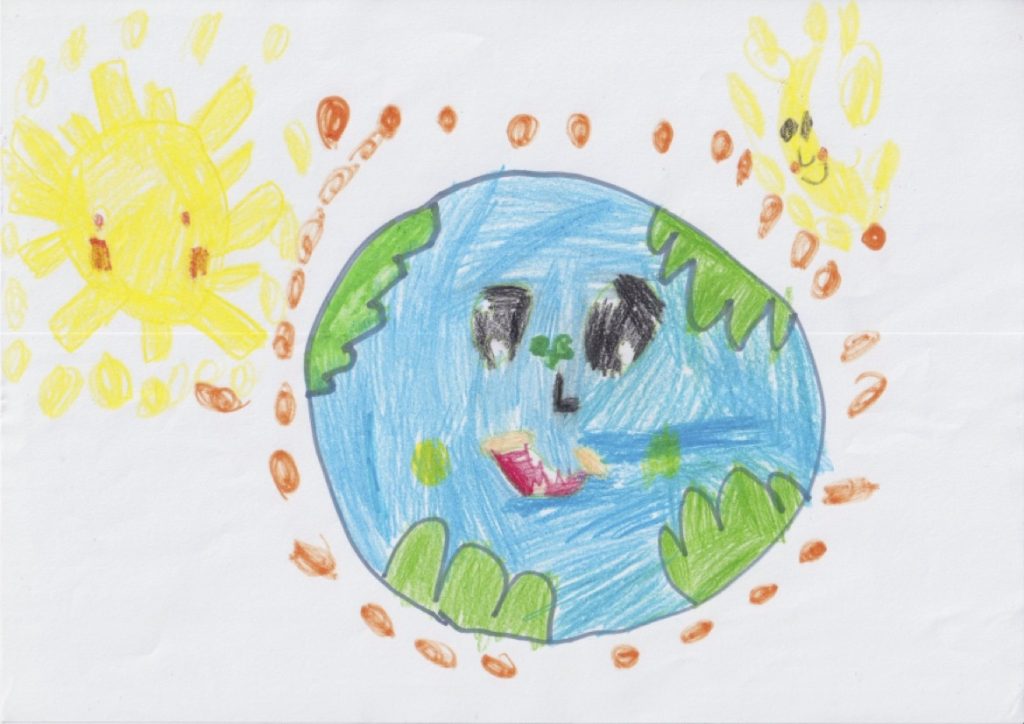
Children’s drawings represent, in this sense, a privileged means of ecological expression. The image presented in this contribution — created by a kindergarten pupil — depicts a smiling Earth surrounded by the sun and vivid colors. The humanization of the planet through facial features such as eyes and a smile immediately conveys a relational message: the Earth is not perceived as a distant object, but as a living, friendly, and fragile reality.
The predominant use of blue, green, and yellow recalls the fundamental elements of life — water, vegetation, and light — while the planet’s smile implicitly suggests an idea of harmony between human beings and the environment. The spontaneity of the child’s artistic expression conveys a vision not yet marked by the utilitarian logic of adulthood, but rather oriented toward wonder, care, and reciprocity.
It is precisely within this symbolic capacity of childhood that an important bioethical lesson emerges: ecology is born not only from fear of catastrophe, but also from the ability to love and recognize the beauty of the world.
5. Environmental Education and Global Citizenship
Contemporary schools are called upon to promote educational pathways integrating environmental sustainability, human rights, and civic responsibility. Initiatives connected to Earth Day represent valuable opportunities to develop transversal competencies, critical thinking, and active participation.
According to UNESCO, schools must transform themselves into “green schools,” capable of educating for sustainability through concrete and participatory practices. (unesco.org) Furthermore, artistic and creative activities addressed to children encourage the internalization of environmental values through emotional and symbolic language. (discoveryeducation.com)
Within this framework, the children’s drawing presented here assumes a value that transcends its aesthetic dimension: it becomes an educational and cultural testimony of a possible alliance between younger generations and the environment.
6. Conclusions
Earth Day on April 22 represents today far more than a symbolic observance: it constitutes a universal ethical appeal to responsibility toward the planet and future generations. In an era marked by climate crisis and the fragility of ecosystems, environmental bioethics invites humanity to profoundly rethink the relationship between human beings and nature.
The drawing created by the kindergarten child acquires, from this perspective, a highly significant value. Through the simplicity of children’s language emerges a vision of the Earth as a living, smiling reality worthy of care. It is precisely in childhood that a new ecological culture may arise, founded not only on scientific knowledge, but also on empathy, wonder, and shared responsibility.
Educating children to care for the Earth ultimately means educating humanity for its own future.
Bibliography
Carson R., Silent Spring, Houghton Mifflin, Boston, 1962.Jonas H., The Imperative of Responsibility, University of Chicago Press, Chicago, 1984.Morin E., The Way: For the Future of Humanity, Hampton Press, New York, 2011.Nussbaum M., Not for Profit: Why Democracy Needs the Humanities, Princeton University Press, Princeton, 2010.Potter V.R., Bioethics: Bridge to the Future, Prentice Hall, New York, 1971.UNESCO, Earth Day: We Must Reconcile Humans with Nature, 2023. (unesco.org)UNESCO, International Mother Earth Day, 2025. (unesco.org)United Nations Environment Programme (UNEP), International Mother Earth Day 2025. (unep.org)United Nations, International Mother Earth Day. (indonesia.un.org)UNESCO, Over 100,000 Schools Have Aligned to UNESCO’s Green School Guidance, 2026. (unesco.org)Discovery Education, 4 Classroom Activities for Earth Day, 2026. (discoveryeducation.com)