Abstract
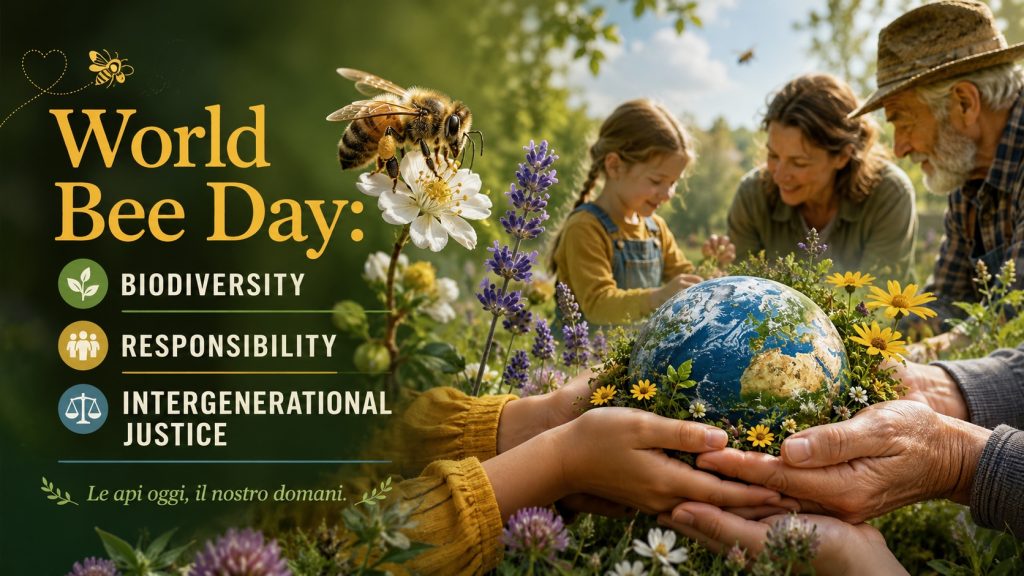
World Bee Day, celebrated annually on May 20, provides an important opportunity to reflect not only on the ecological value of pollinators but also on the ethical, social, and economic implications associated with their progressive decline. Bees represent an essential component of biodiversity conservation, food security, and ecosystem stability. Their decline, driven by factors such as climate change, habitat loss, pesticide use, and intensive agriculture, raises questions that extend beyond the strictly biological sphere to encompass bioethics, sustainability, and responsibility toward future generations. Through an interdisciplinary perspective, this article examines the role of pollinators as indicators of environmental health and proposes a reflection on the moral duty to promote development models compatible with ecosystem protection.
Keywords: bees; biodiversity; environmental bioethics; sustainability; pollination; One Health; intergenerational responsibility.
Introduction
Among the many international observances promoted by the United Nations, World Bee Day holds particular significance because of its ability to draw attention to an issue that may appear limited in scope but is, in fact, crucial to the future of humanity. Bees are not merely one of the most familiar species in the animal kingdom; they are among the biological pillars that sustain the functioning of terrestrial ecosystems.
The establishment of this observance by the United Nations General Assembly in 2017 reflects the growing scientific awareness of the role of pollinators in maintaining biodiversity and supporting global food production. What was long regarded as a self-evident natural process—the transfer of pollen from one flower to another—is now recognized as one of the most valuable and, at the same time, most vulnerable ecosystem services.
Bees have become a symbol of a broader ecological crisis involving the relationship between human activities and natural systems. Their gradual decline is not merely a concern for beekeepers or ecologists; it is a warning signal that challenges society as a whole.
The Ecological Role of Bees: Much More Than Honey
Public perception frequently associates bees with the production of honey, beeswax, and other hive products. While these activities possess considerable economic and cultural significance, the primary contribution of bees lies in their role as pollinators.
Pollination is a fundamental process for the reproduction of a large proportion of flowering plants. By transporting pollen, insects facilitate plant fertilization, ensuring the production of seeds and fruits. This mechanism supports natural biodiversity and contributes significantly to agricultural productivity.
Numerous crops of global nutritional importance depend, to varying degrees, on pollinator activity, including fruits, vegetables, legumes, oilseed crops, and many forage species. The absence or reduction of these organisms would have substantial consequences not only in quantitative terms but also with regard to nutritional quality.
Bees also serve as important biological indicators of environmental quality. Their sensitivity to ecological disturbances makes them a form of “ecological sentinel,” capable of revealing imbalances that may otherwise remain unnoticed.
Contemporary Threats to Pollinators
For several years, the scientific community has documented a significant decline in pollinator populations across many regions of the world. This phenomenon results from the interaction of multiple factors, often acting synergistically.
Among the principal causes is the loss of natural habitats. Urban expansion, land fragmentation, and the intensification of agricultural practices have progressively reduced the availability of environments suitable for bee survival.
Another critical factor is the use of chemical substances in agriculture. Although pesticides have contributed to increased crop productivity, certain active ingredients may impair the cognitive, reproductive, and immune functions of pollinators.
Climate change also exerts an increasingly significant impact. Rising average temperatures, the growing frequency of extreme weather events, and alterations in seasonal cycles affect the synchronization between plant flowering periods and pollinator activity.
Additional pressures include the spread of parasites and pathogens, atmospheric pollution, and the ongoing reduction of biological diversity. The result is an ecological system that is increasingly fragile and less resilient.
A Bioethical Interpretation of the Pollinator Crisis
The decline of bee populations cannot be understood solely as a biological or economic issue. It raises profound questions regarding the way human beings conceive their relationship with nature.
Contemporary bioethics has progressively expanded its field of reflection. While initially focused primarily on clinical and biomedical issues, it has become increasingly evident that environmental dimensions must also be included among the central themes of ethical inquiry.
Environmental bioethics emphasizes the awareness of interdependence among all forms of life. From this perspective, human health cannot be separated from the health of ecosystems. The pollinator crisis thus becomes a symbol of a broader relational crisis concerning the way contemporary societies use and transform natural resources.
The fundamental ethical question concerns limits. To what extent is it legitimate to pursue productive models that generate immediate benefits while compromising the regenerative capacity of ecosystems? What responsibilities do we bear toward the species with which we share the planet?
Such questions evoke the precautionary principle, which has become increasingly relevant in contemporary environmental policies. When potentially serious risks to ecosystems exist, the absence of absolute certainty should not justify inaction.
Bees and Intergenerational Justice
Reflecting on bees inevitably leads to the concept of intergenerational justice.
Each generation inherits a natural heritage that has developed over millennia and bears the responsibility of transmitting it, at the very least, in an intact condition to future generations. The loss of biodiversity represents a form of collective impoverishment that limits future opportunities and reduces the resilience of natural systems.
The protection of pollinators therefore assumes an ethical dimension that transcends the present. It is not merely a matter of safeguarding a particular animal species but of preserving ecological conditions that are essential for the lives of future generations.
Sustainability cannot be interpreted solely as an economic strategy. Above all, it constitutes a principle of justice, grounded in the recognition of future generations’ right to benefit from a healthy and functional environment.
The One Health Paradigm: An Integrated Perspective
In recent years, the One Health paradigm has gained increasing prominence in international health and environmental policies. This approach recognizes the profound interconnection between human health, animal health, and ecosystem health.
Bees provide a particularly effective example of this interdependence. Their survival depends on environmental quality; environmental quality influences agricultural production; and agricultural production affects the health and well-being of human populations.
From this perspective, the protection of pollinators is not a marginal or sector-specific issue but rather an essential component of global strategies for public health and sustainable development.
Education, Participation, and Ecological Citizenship
Protecting bees requires regulatory interventions, scientific investment, and innovative agricultural policies. However, no transformation will be truly effective without a cultural shift.
Environmental education plays a decisive role in fostering ecologically responsible citizenship. Understanding the value of pollinators means developing a broader awareness of the relationships that sustain life on Earth.
Citizen participation can take the form of concrete actions: encouraging the cultivation of pollinator-friendly plant species in urban environments, reducing the use of chemical products in private gardens, supporting sustainable agricultural practices, and promoting public awareness initiatives.
Even small actions acquire significance when they become part of a culture of shared responsibility.
Conclusions
World Bee Day invites us to look beyond the symbolic dimension of the observance. Bees represent an essential component of the ecological network that makes life on Earth possible and, at the same time, a powerful indicator of the vulnerabilities generated by current development models.
Their progressive decline highlights the need to rethink the relationship between human activities and the environment according to principles of sustainability, precaution, and responsibility. Environmental bioethics offers valuable conceptual tools for understanding this challenge and for guiding more conscious individual and collective choices.
Protecting bees means protecting biodiversity, food security, and ecosystem health. Above all, it means recognizing that the future of humanity is inseparable from the future of the natural world of which humanity itself is a part.
References
Food and Agriculture Organization (FAO). (2024). World Bee Day: Bee engaged with youth. Rome: FAO.
Intergovernmental Science-Policy Platform on Biodiversity and Ecosystem Services (IPBES). (2016). The Assessment Report on Pollinators, Pollination and Food Production. Bonn: IPBES Secretariat.
Jonas, H. (1984). The Imperative of Responsibility: In Search of an Ethics for the Technological Age. Chicago: University of Chicago Press.
Klein, A. M., Vaissière, B. E., Cane, J. H., Steffan-Dewenter, I., Cunningham, S. A., Kremen, C., & Tscharntke, T. (2007). Importance of Pollinators in Changing Landscapes for World Crops. Proceedings of the Royal Society B, 274(1608), 303–313.
Leopold, A. (1949). A Sand County Almanac. New York: Oxford University Press.
Potts, S. G., Biesmeijer, J. C., Kremen, C., Neumann, P., Schweiger, O., & Kunin, W. E. (2010). Global Pollinator Declines: Trends, Impacts and Drivers. Trends in Ecology & Evolution, 25(6), 345–353.
United Nations. (2017). Resolution Adopted by the General Assembly on 20 December 2017: World Bee Day (A/RES/72/211). New York: United Nations.
World Health Organization. (2023). One Health Joint Plan of Action (2022–2026). Geneva: WHO.