Abstract
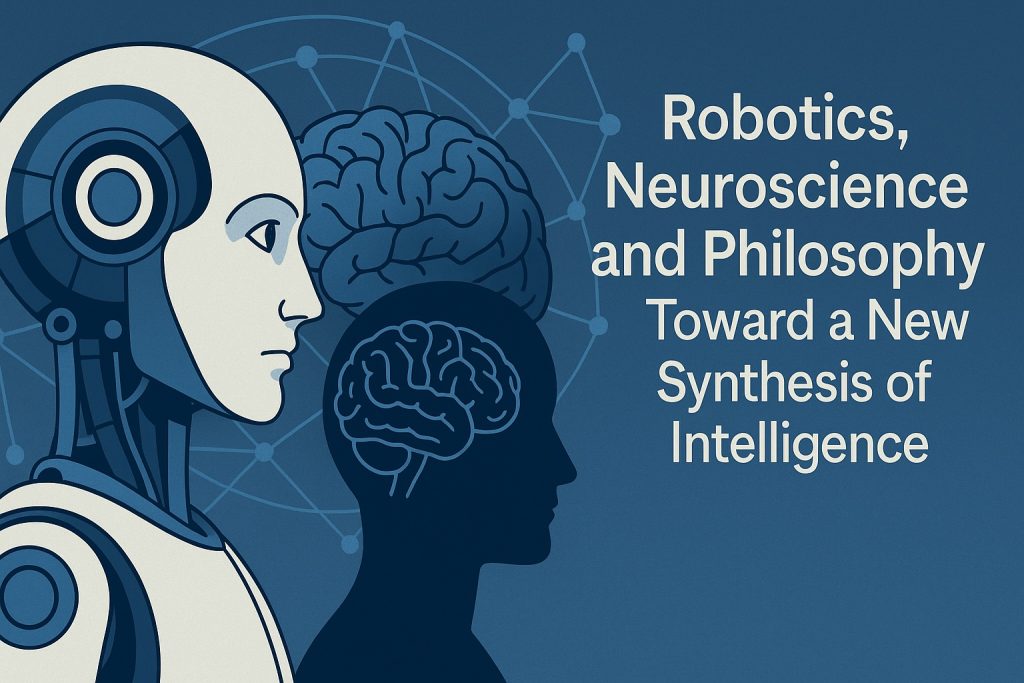
This article explores the intersection of robotics, neuroscience, and philosophy, with the aim of outlining a new theoretical framework for interpreting the development of artificial intelligence in an embodied, situated, and relational key. The convergence between neuroscientific models, robotic architectures, and philosophical reflection suggests that intelligence—both natural and artificial—is not merely a computational process, but an emerging phenomenon rooted in the body, the environment, and the dynamic interaction among systems. The article offers a critical reading of contemporary neurorobotics, examines the implications of embodied cognition, and analyzes the contribution of phenomenological, enactivist, and externalist perspectives in defining the limits and potential of artificial intelligence.
Introduction
In recent years, robotics and neuroscience have established an increasingly close relationship, driven by the desire to understand and replicate the mechanisms underlying intelligent behavior. However, this convergence cannot be fully understood without an adequate philosophical framework. Philosophy of mind, phenomenology, and complex systems theory provide crucial conceptual tools for interpreting scientific findings and for identifying the implicit assumptions within theories of artificial intelligence. This article proposes an integrated approach, showing how robotics, neuroscience, and philosophy can illuminate one another and generate renewed critical thought about intelligence.
Robotics and Neuroscience: Emerging Models
Neurorobotics represents one of the most promising fields in the attempt to apply neuroscientific principles to the design of autonomous artificial systems. Deep neural networks, predictive models of the brain, and theories of sensorimotor integration have significantly influenced the way cognitive robots are built. In these architectures, learning does not occur as simple data storage, but through processes of plastic adaptation that reflect biological mechanisms. The growing attention to the embodied nature of machines suggests that intelligence cannot be understood apart from a body that perceives, moves, and interacts with the environment.
Philosophy of Mind, Embodied Cognition, and the Extended Mind
Contemporary philosophy provides essential tools for interpreting both natural and artificial intelligence. Merleau-Ponty’s phenomenology emphasizes the indissoluble link between body and perception, while the extended mind theories of Clark and Chalmers show how cognitive processes can extend beyond the biological boundaries of the organism. Enactivism, proposed by Varela, Thompson, and Rosch, interprets cognition as a dynamic process of co-construction between agent and environment. These perspectives challenge the idea of the mind as an abstract computational device, instead opening the way to models of situated and relational intelligence that profoundly shape current conceptions of robotics.
Simulation, Understanding, and the Limits of Artificial Consciousness
A neural network can successfully simulate complex human behaviors without possessing any form of understanding or consciousness. From a philosophical perspective, this raises crucial questions: is it possible to generate understanding through simulation? Is consciousness an emergent phenomenon, an embodied process, or an irreducible attribute of subjective experience? Neuroscience does not yet provide a definitive theory of consciousness, making an ongoing dialogue with philosophy essential—philosophy having grappled with these issues for centuries. Consequently, robotics must acknowledge its conceptual limits when attempting to model phenomena that are not yet fully understood even within biology.
Ethics, Responsibility, and the Society of Machines
The integration of autonomous robots into society raises significant ethical questions. What degree of responsibility can be attributed to an autonomous machine? Is it possible to consider a robot as a moral agent? What criteria should guide the ethical design of intelligent systems? Answers to such questions require an interdisciplinary approach involving applied ethics, the philosophy of technology, and decision theory. The responsible development of robotics cannot be separated from philosophical reflection on the social and moral implications of artificial autonomy.
Conclusions
The article shows that the future of artificial intelligence cannot be understood or developed without a profound convergence between robotics, neuroscience, and philosophy. Intelligence, far from being a mere algorithm, appears as an embodied, distributed, situated, and relational phenomenon. The robotics of the future will increasingly need to integrate neuroscientific principles and philosophical reflection in order to generate systems capable not only of high performance, but also of contextual awareness, adaptability, and ethical responsibility.
Bibliografia
Damasio, A. (1999). *The Feeling of What Happens*. Harcourt.
Gazzaniga, M. (2018). *The Consciousness Instinct*. Farrar, Straus and Giroux.
Kandel, E. (2006). *In Search of Memory*. W. W. Norton.
Edelman, G. (1992). *Bright Air, Brilliant Fire*. Basic Books.
Brooks, R. (1991). Intelligence Without Representation. *Artificial Intelligence*.
Pfeifer, R., & Bongard, J. (2007). *How the Body Shapes the Way We Think*. MIT Press.
Clark, A. (1997). *Being There*. MIT Press.
Chalmers, D. (1996). *The Conscious Mind*. Oxford University Press.
Varela, F., Thompson, E., & Rosch, E. (1991). *The Embodied Mind*. MIT Press.
Floridi, L. (2013). *The Ethics of Information*. Oxford University Press.
Coeckelbergh, M. (2020). *AI Ethics*. MIT Press.
Merleau-Ponty, M. (1945). *Phénoménologie de la perception*. Gallimard.
Prigogine, I., & Stengers, I. (1984). *Order Out of Chaos*. Bantam Books.