Abstract
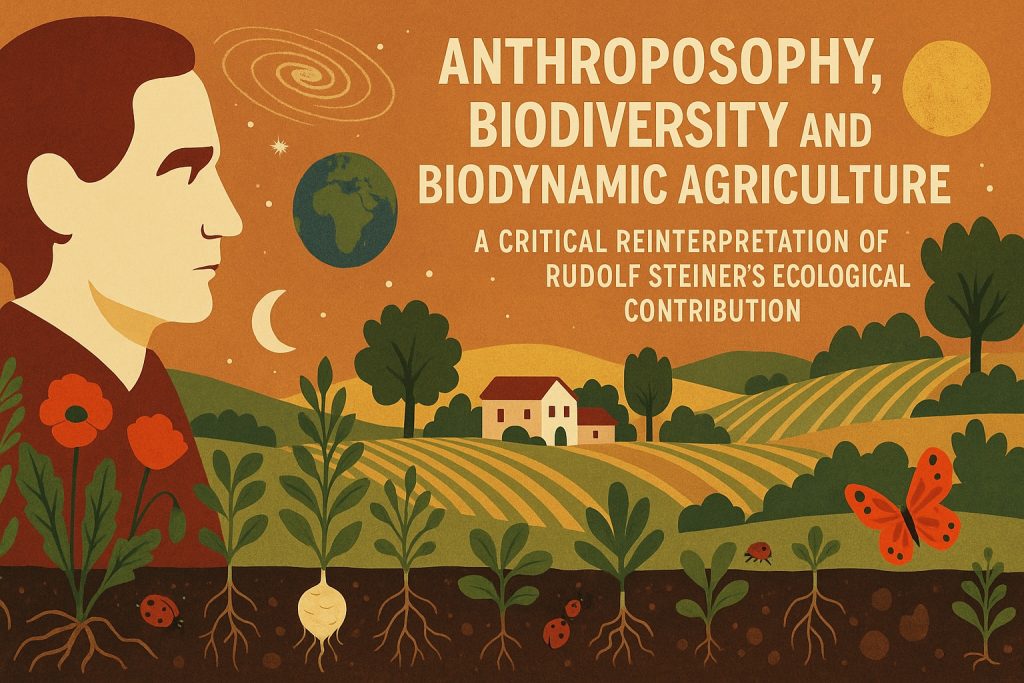
This article offers an in-depth and entirely original analysis of the relationship between anthroposophy, biodiversity, and biodynamic agriculture, with particular attention to Rudolf Steiner’s role as an original interpreter of nature and a forerunner of alternative forms of ecological thought. Through an interdisciplinary approach integrating philosophy, the history of ideas, complex systems ecology, and contemporary agronomic research, the article investigates the potential and the limits of the anthroposophical paradigm in the context of current environmental crises, assessing the coherence and effectiveness of biodynamic practices in relation to the goals of sustainability and biodiversity conservation.
Introduction
The global decline of biodiversity represents one of the major challenges facing ecosystems in the 21st century. This crisis has driven the search for agricultural models that are more resilient and respectful of biological complexity. In this context, the thought of Rudolf Steiner—founder of anthroposophy and inspiration for biodynamic agriculture—offers a surprising contribution in terms of conceptual depth and ecological insight. Although rooted in a spiritual vision of nature, his approach proposes elements that correspond to modern scientific paradigms such as complex systems ecology, resilience theory, and agroecology.
Methodology
The article adopts a qualitative and interdisciplinary method based on three main axes: (1) a historical-philosophical analysis of Steiner’s works, particularly the 1924 Agriculture Course; (2) a critical review of the scientific literature on biodiversity, soil fertility, and biodynamic practices; (3) an epistemological comparison between spiritual and scientific models, in order to identify convergences, divergences, and potential areas for dialogue.
Anthroposophy and the Philosophy of Nature
Anthroposophy interprets nature as a living organism endowed with internal functions, rhythms, and dynamics that transcend the purely material dimension. Steiner assigns biological diversity an essential role in maintaining the Earth’s balance, describing living beings as expressions of qualitative processes and formative forces. Although not scientific in the traditional sense, this perspective presents surprising affinities with modern approaches that emphasize interdependence, complexity, and systemic vision.
The 1924 Agriculture Course
The Agriculture Course, delivered by Steiner in 1924, marks the birth of biodynamic agriculture. In it, Steiner proposes an innovative conception of the farm as a self-sufficient organism, the centrality of soil fertility, the integration of livestock and crop cultivation, and the valorization of closed biological cycles. Many of these principles are now considered fundamental in agroecological practice and regenerative agriculture.
Biodiversity in Steiner’s Perspective
Steiner does not use the modern term “biodiversity”, yet he develops a concept that is functionally equivalent: the variety of living forms as a condition of harmony within the organism Earth. Biological diversity is not viewed merely as a measurable quantity, but as an intrinsic quality of living systems, essential for ecological stability and soil vitality.
Biodynamics and Scientific Research
Scientific literature from recent decades has highlighted positive effects of biodynamic practices on soil fertility, microbial biodiversity, and the resilience of agricultural ecosystems. These benefits derive primarily from the agronomic practices employed—such as composting, crop rotation, and diversification—rather than from the esoteric aspects of biodynamic preparations. Nevertheless, controversies persist, especially due to the difficulty of experimentally assessing the anthroposophical theoretical components.
Discussion
Comparative analysis reveals significant convergence between the practical principles of biodynamic agriculture and the scientific models of agroecology, soil regeneration, and systemic ecosystem management. The main divergence lies in the epistemological framework: while modern science is grounded in verifiability and material causality, anthroposophy incorporates symbolic and spiritual interpretations. Despite this, the contribution of biodynamics to sustainability is today recognized by numerous international studies.
Conclusions
Rudolf Steiner’s thought, although characterized by a spiritual framework, offers a body of insights that prove surprisingly relevant to today’s debates on biodiversity and agricultural sustainability. Biodynamics represents a significant example of how models originating outside official science can contribute to ecological regeneration and the enhancement of vital resources. The dialogue between spiritual and scientific approaches—if conducted with critical rigor—can generate new perspectives for addressing the environmental challenges of the future.
Bibliografia
Steiner, R. (1924). Geisteswissenschaftliche Grundlagen zum Gedeihen der Landwirtschaft.
Steiner, R. (1894). Die Philosophie der Freiheit.
Paull, J. (2011). Biodynamic agriculture: The journey from Koberwitz.
Mäder, P. et al. (2002). Soil fertility and biodiversity in organic farming.
Reganold, J. (1993). Soil quality analysis of biodynamic vs conventional farms.
Altieri, M. (1995). Agroecology: The Science of Sustainable Agriculture.
Gliessman, S. (2014). Agroecology: Ecology of Sustainable Food Systems.
Bengtsson, J. (2005). Organic agriculture and biodiversity: A meta-analysis.