1. Introduction
CRISPR-based genome editing has rapidly become one of the most influential innovations in contemporary biomedical science. Unlike earlier genetic engineering techniques, CRISPR systems allow researchers to target, cut, and rewrite DNA sequences with high specificity and relative simplicity. These capabilities open possibilities for treating inherited disorders, enhancing disease research models, and potentially reshaping human health on a population scale.
Despite its promise, human genome editing forces society to confront sensitive ethical questions and exposes gaps in current regulatory frameworks. Understanding these dimensions is essential for navigating the future of this technology.
2. Biomedical Perspectives
2.1 How CRISPR Works
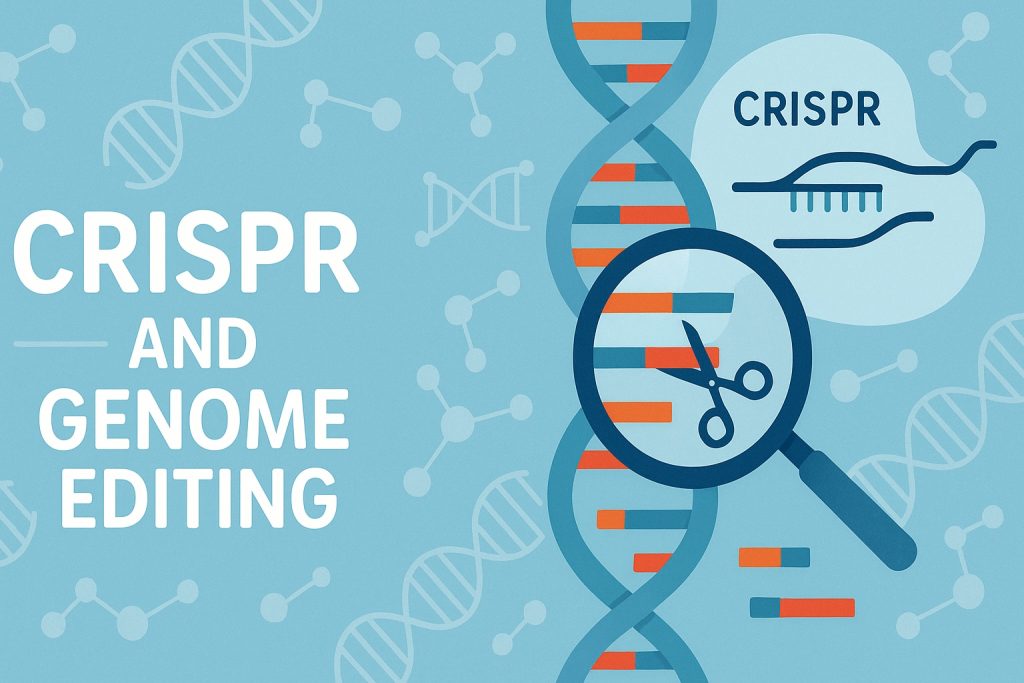
CRISPR (Clustered Regularly Interspaced Short Palindromic Repeats) originated as a microbial immune defense. In laboratory applications:
- A guide RNA recognizes a specific DNA sequence.
- The Cas enzyme (commonly Cas9 or Cas12) introduces a targeted cut.
- Cellular repair pathways then incorporate insertions, deletions, or substitutions.
Recent innovations—such as base editors and prime editors—enable genetic changes without double-stranded breaks, reducing unwanted mutations.
2.2 Therapeutic and Scientific Applications
CRISPR is now central to many biomedical efforts:
Somatic Editing (non-heritable)
- Correction of single-gene diseases (e.g., hemoglobinopathies)
- Engineering immune cells for more effective cancer therapies
- Investigational treatments for viral infections by disrupting proviral DNA
Germline Editing (heritable)
Though not authorized for clinical use, research suggests potential applications in:
- Preventing severe monogenic disorders
- Reducing inherited predispositions to metabolic or neurodegenerative diseases
- Modifying early embryos for reproductive purposes
These approaches remain ethically sensitive because changes affect future generations.
2.3 Benefits and Technical Barriers
Benefits
- Precision and adaptability across diverse genetic targets
- Potential to create curative, one-time treatments
- Acceleration of disease modeling and drug discovery
Barriers and Risks
- Off-target modifications with unpredictable physiological outcomes
- Inefficient delivery methods for certain organs and tissues
- Complex genetic interactions not yet fully understood
- Need for long-term safety data
3. Ethical Issues
3.1 Distinction Between Treatment and Enhancement
One of the core ethical debates concerns whether genome editing should be limited strictly to therapeutic uses or extended to enhancement purposes. Therapies aimed at correcting debilitating genetic conditions generally receive broader acceptance, while enhancements—such as modifying cognition, strength, or aesthetic traits—raise concerns about identity, diversity, and social pressure.
3.2 Autonomy and Consent
In somatic editing, individuals can provide informed consent. In germline editing, however, the individuals most affected—the future children—cannot. This presents challenges regarding autonomy, responsibility, and the rights of future generations.
3.3 Justice and Global Equity
CRISPR-based therapies are likely to be expensive, at least initially. This may widen health disparities between:
- wealthy and low-income populations
- technologically advanced and developing countries
- individuals with private access to emerging genetic interventions vs. those without
There is also concern about “reproductive tourism” in countries with permissive or unclear regulations.
3.4 Social and Genetic Inequality
If enhancement editing becomes accessible, societies could drift toward genetic stratification, where desirable genetic traits correlate with socioeconomic privilege. Such scenarios could revive forms of modern eugenics, intentionally or unintentionally.
3.5 Environmental and Ecological Considerations
CRISPR gene drives, designed to spread specific genetic traits through wild populations, offer strategies against vector-borne diseases. But they also carry ecological risks, potentially destabilizing habitats and altering evolutionary trajectories in irreversible ways.
4. Regulatory Challenges
4.1 A Fragmented Global Landscape
Policies governing human genome editing differ markedly across countries:
- Some nations permit somatic editing under strict clinical trial oversight.
- Many explicitly ban clinical germline editing.
- Others have ambiguous or outdated legislation.
This fragmentation complicates international cooperation and increases the risk of ethically questionable experiments.
4.2 Key Regulatory Priorities
To ensure responsible use, policymakers must address:
- Safety Standards – Defining acceptable risk levels, off-target thresholds, and monitoring requirements.
- Ethical Oversight – Ensuring transparent review boards and public involvement in decision-making.
- International Coordination – Developing shared norms to prevent regulatory loopholes.
- Data Governance – Establishing rules for genetic data storage, privacy, and access.
- Distinction of Applications – Regulating therapy and enhancement differently, with clear boundaries.
4.3 Toward a Cooperative Global Framework
Several international organizations—including WHO, UNESCO, and the International Society for Stem Cell Research—propose guidelines advocating caution, transparency, and global dialogue. Many experts support a temporary moratorium on clinical germline editing until consensus on scientific and ethical standards is reached.
5. Conclusion
CRISPR and human genome editing represent one of the most transformative scientific frontiers of the 21st century. Their potential to alleviate human suffering is immense, but so are the ethical and societal risks if deployed without careful oversight. A balanced future requires integrating scientific rigor, ethical reflection, and robust global regulation. Only through collective responsibility can this technology evolve in a way that respects human dignity and promotes equitable health outcomes.
Bibliografia
Libri e Monografie
- Doudna, J.A., & Sternberg, S.H. A Crack in Creation: Gene Editing and the Unthinkable Power to Control Evolution. Houghton Mifflin Harcourt, 2017.
- Lander, E. The Future of Genome Editing. MIT Press, 2021.
- Baylis, F. Altered Inheritance: CRISPR and the Ethics of Human Genome Editing. Harvard University Press, 2019.
Articoli Scientifici
- Jinek, M. et al. “A Programmable Dual-RNA–Guided DNA Endonuclease in Adaptive Bacterial Immunity.” Science, 2012.
- Komor, A.C., Kim, Y.B., Packer, M.S., Zuris, J.A., & Liu, D.R. “Programmable Editing of a Target Base in Genomic DNA Without Double-Stranded DNA Cleavage.” Nature, 2016.
- Kleinstiver, B.P. et al. “High-Fidelity CRISPR–Cas9 Nucleases with No Detectable Genome-Wide Off-Target Effects.” Nature, 2016.
Organizzazioni e Rapporti Istituzionali
- World Health Organization (WHO). Human Genome Editing: Recommendations. WHO, 2021.
- International Society for Stem Cell Research (ISSCR). Guidelines for Stem Cell Research and Clinical Translation. ISSCR, 2021.
- Nuffield Council on Bioethics. Genome Editing and Human Reproduction: Ethical Issues. 2018.